News
2026
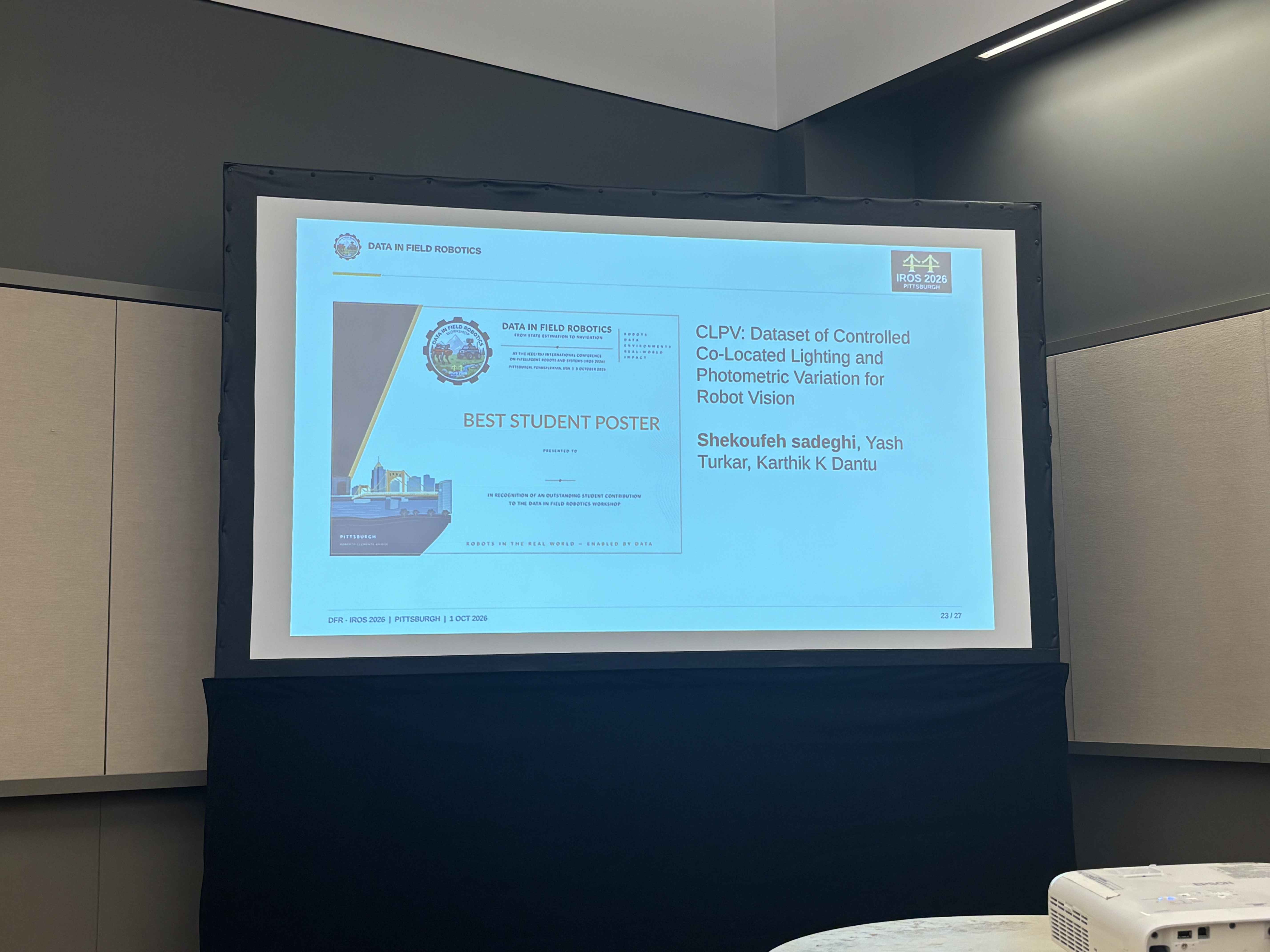
[Sep 26] DRONES Lab goes to IROS. We had 1 workshop invited talk, 2 conference papers, and 12 workshop papers across 7 workshops at IROS 2026. Our work received 2 workshop awards: the Best Paper Runner-Up Award at the Bridge4Nav workshop for “Learning When to Jump for Off-road Navigation,” and Best Student Poster at the Data in Field Robotics workshop for “CLPV: Dataset of Controlled Co-Located Lighting and Photometric Variation for Robot Vision.” Congratulations to both teams!
Links: DRONES Lab at IROS — talks and papers · Bridge4Nav award certificate · Data in Field Robotics award announcement
[Sep 26] Our paper AnyNav: Visual Neuro-Symbolic Friction Learning for Off-road Navigation has been accepted to The International Journal of Robotics Research (IJRR). Congratulations to Taimeng Fu and the SAIR Lab team!
Links: Project Homepage · Paper
[Aug 26] Our recycled-plastics sensing technology co-led by Charuvahan Adhivarahan received a 2026 R&D 100 Award and R&D 100 Special Recognition in Corporate Social Responsibility (Bronze). Developed with our UB collaborators, the technology combines sensing techniques and machine learning to measure recycled plastic content in commercial products.
Links: UB article · R&D 100 winners · Corporate Social Responsibility award · The Buffalo News · UB Engineering on LinkedIn · SourceARUN
[Aug 26] Our work CLEAR has been accepted to IEEE Robotics and Automation Letters (RA-L). This work is part of the larger ONR project GRAPPLE on courses-of-action planning for multi-agent systems. Congratulations to Pranay Meshram and the team!
Links: Project Homepage · Paper
[Jul 26] Our article “Adaptive Hiking-Time Prediction Through State-Dependent Energy Regulation” has been published in IEEE Transactions on Biomedical Engineering (T-BME). Congratulations to Kristian Dalland from the Human-in-the-Loop Systems Laboratory (HILS) and Prof. Ehsan Esfahani for leading this work!
Links: Paper
[Feb 26] Our article “Comparative Analysis of Feature Tracking Challenges in Unstructured Space Environments” has been published in IEEE Transactions on Aerospace and Electronic Systems (TAES). The study evaluates ten handcrafted and learning-based visual features using real space imagery from surface, aerial, and orbital viewpoints, alongside Earth-based benchmarks. It examines how changing illumination, low-texture surfaces, and repetitive terrain make features difficult to track, offering insights toward more reliable visual navigation for future spacecraft. Congratulations to TJ Chase for leading this work, with co-author Andrew Balotin!
Links: Paper